FedRAMP Class A: How SOC 2 Holders Can Enter the Federal Market
Everything you need to know about FedRAMP Class A, a new designation introduced under FedRAMP 20x to help get more businesses into the FedRAMP Marketplace.


The federal market has always been difficult to break into, especially for modern SaaS and cloud-native companies. Traditional FedRAMP Rev5 authorization required an agency sponsor to open the door, then, by common industry estimates, a 12–18-month timeline as you prepared for authorization, and often $500K–$1M+ in costs.
Now, things are changing. Since August 3, 2026, FedRAMP's new Class A certification lets you list in the FedRAMP Marketplace using a SOC 2 Type II report (or a recent GovRAMP, FedRAMP Rev5, or FedRAMP Ready assessment), without an agency sponsor. The catch? Class A is an on-ramp, not a destination. Once you're through the door with Class A, you must schedule an assessment for a full Class B, C, or D certification within two years of your initial Marketplace listing in order to stay in the Marketplace.
Ready to start? Read our step-by-step SOC 2 to Class A guide and grab the free templates (no form): a Class A project plan, a SOC 2 to Class A crosswalk, an evidence checklist, a policy addenda pack, and a Certification Package JSON guide.
What Is FedRAMP Class A?
FedRAMP Class A is a new entry-level FedRAMP certification that lets a cloud service provider get listed in the FedRAMP Marketplace by leveraging an existing commercial security assessment, such as a SOC 2 Type II report, with no agency sponsor required.
Class A is the lowest of four FedRAMP certification classes (A, B, C, and D) introduced in the FedRAMP Consolidated Rules for 2026 (CR26). CR26's lettered classes replace the old Low, Moderate, and High labels, so that a cloud service's certification class isn't confused with the impact level agencies must set for their own systems under FIPS 199/200 and OMB Circular A-130. The swap isn't one-to-one, though: Class A is a new designation, while Classes B, C, and D loosely align with the old Low, Moderate, and High baselines.
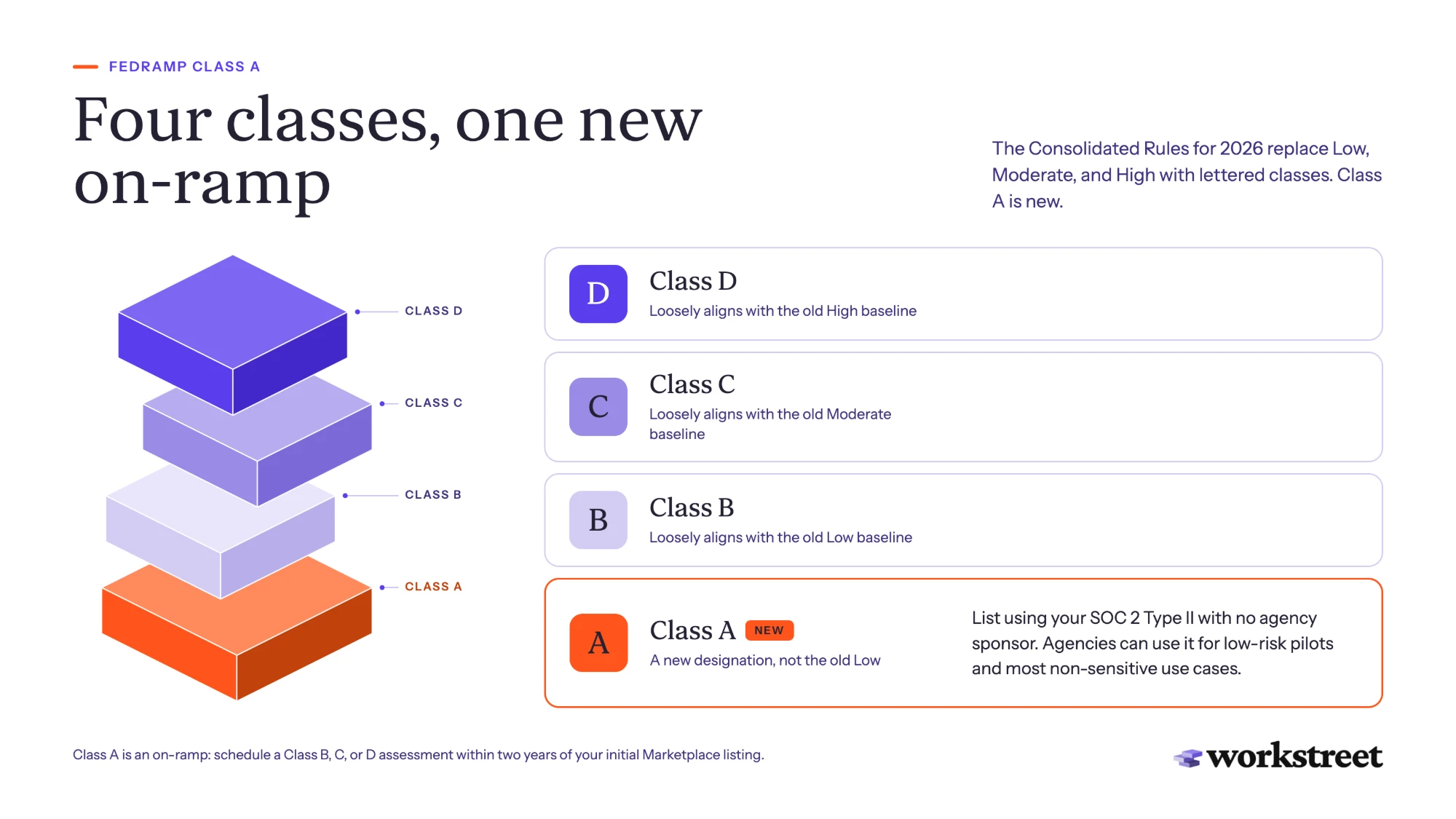
Class A doesn't require an agency sponsor, a requirement that previously locked many startups and cloud service providers (CSPs) out of the federal market. Instead, it's available through Program Certification via the FedRAMP Program Management Office (PMO).
Before you apply for Class A, you get an Initial Implementation Phase listing in the FedRAMP Marketplace, which FedRAMP offers to providers actively preparing for a certification. Your two-year window to schedule a Class B, C, or D assessment starts at that listing. With Class A certification, agencies can use your service for low-risk pilots and most non-sensitive use cases. At Class A, a federal agency could also require you to meet additional requirements and implement further controls.
When Can You Apply for FedRAMP Class A?
The FedRAMP Class A pipeline opened on August 3, 2026, and FedRAMP granted the first 20x Class A certification on August 25, 2026. If you already hold a current SOC 2 Type II report, you can start now. The Consolidated Rules become mandatory on January 1, 2027.
Here are the key dates you need to know:
| Date | What happens |
|---|---|
| June 24, 2026 | FedRAMP launches the Consolidated Rules for 2026 (CR26) |
| July 4, 2026 | Optional early adoption of CR26 begins; transition to the new certification model starts |
| July 6, 2026 | Marketplace listings open for initial-implementation providers |
| July 28, 2026 | FedRAMP Ready becomes “Legacy FedRAMP Ready”; no new FedRAMP Ready submissions |
| August 3, 2026 | The Class A pipeline opens for submissions |
| August 31, 2026 | The Class B and Class C pipelines open |
| January 1, 2027 | CR26 takes mandatory effect for all stakeholders; over the following year, all providers must follow the rules to keep their FedRAMP certification |
| June 11, 2027 | Last day to apply for a new Rev5 certification |
Why FedRAMP Opened a SOC 2 On-Ramp
FedRAMP is keen to open the door to more innovative, cloud-native businesses that the Rev5 authorization path locked out.
By opening Class A to organizations holding a valid SOC 2 Type II report (or a recent GovRAMP, FedRAMP Rev5, or FedRAMP Ready assessment) and removing the need for an agency sponsor, FedRAMP gives most commercial CSPs a route into the Marketplace.
The path was first discussed in the Office of Management and Budget memo M-24-15, which directed FedRAMP to expand the Marketplace and add new authorization paths. RFC-0022 proposed leveraging external commercial frameworks to do it, and the Initial Outcome in NTC-0007 named SOC 2 Type II as the initial test case. The final Consolidated Rules for 2026 (FRC-CLA-ASF) also accept a recent GovRAMP or FedRAMP Rev5 (including FedRAMP Ready) assessment.
The reason FedRAMP started with SOC 2 is practical, and it says something about who FedRAMP wants to attract. It's something that most commercial CSPs that sell into the enterprise already have in place, and it's also the framework agencies lean on most when they evaluate a commercial product for a low-risk pilot. It also shows FedRAMP's motivation to appeal to commercial CSPs.
Who Qualifies for FedRAMP Class A?
A CSP will qualify for Class A with a recognized commercial security assessment completed within the last 12 months. The eligible frameworks under rule FRC-CLA-ASF are:
- SOC 2 Type II
- GovRAMP at any historical impact level
- An existing FedRAMP Rev5 or FedRAMP Ready assessment at any historical impact level
For most companies reading this, that means a current SOC 2 Type II.
These accepted assessments are what FedRAMP calls Approved Alternative Security Frameworks.
Approved Alternative Security Framework (AASF): A recognized commercial attestation or assessment that FedRAMP will accept as a starting foundation for Class A, used alongside FedRAMP-specific requirements rather than in place of them.
ISO 27001, HITRUST, StateRAMP, and CMMC Level 2 were all proposed in the original RFC and may be added later based on demand and FedRAMP's review capacity, but they can't currently be used for a Class A submission.
What Carries Over From Your SOC 2?
A SOC 2 Type II report gets you to the starting line, but Class A layers in some additional FedRAMP-specific requirements on top of your existing SOC 2 report or other qualifying assessment.
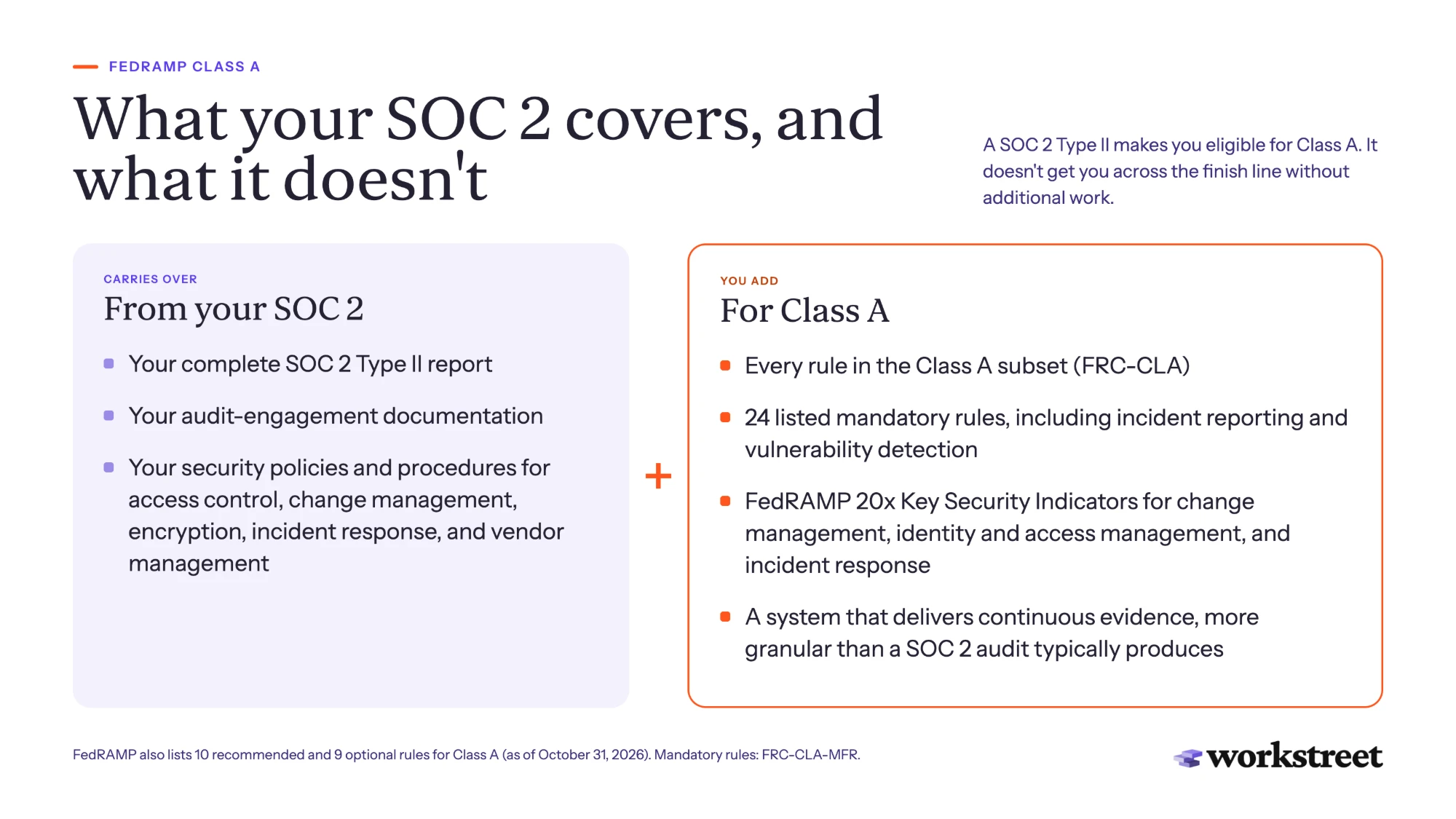
FedRAMP's evidence rule for Class A, FRC-CLA-EAM, requires you to submit your complete SOC 2 report and audit-engagement documentation as part of the certification package. The security policies and procedures across access control, change management, encryption, incident response, and vendor management also carry over for Class A. To see how every Class A rule maps to typical SOC 2 evidence, use our free SOC 2 to Class A crosswalk.
What Your SOC 2 Doesn't Cover for Class A
Alongside your SOC 2 Type II report, you'll also need to meet FedRAMP's mandatory Class A rules to achieve a Class A certification: every rule in the Class A subset (FRC-CLA) plus 24 listed mandatory rules, including SDR-CSX-KSI, which FedRAMP added on October 31, 2026. FedRAMP also lists 10 recommended rules (it removed CPO-CSF-CPM on October 31, 2026) and 9 optional ones. The required rules span incident reporting, vulnerability detection, and a set of FedRAMP 20x Key Security Indicators (KSIs) covering change management, identity and access management, and incident response. All must-have controls will need to be implemented, tested, and validated in order to achieve Class A.
You may also need to provide additional documentation and more granular evidence than a SOC 2 Type II audit typically produces. The KSIs also require a system that delivers continuous evidence, which goes beyond what SOC 2 asks for. Expect your policies to need addenda rather than rewrites; our free policy addenda pack covers the federal-specific rules.
In short, a SOC 2 Type II report can make your organization eligible for the Class A path, but it doesn't get you across the finish line without additional work.
How Do You Get a FedRAMP Class A Certification?
The path to Class A is relatively short compared to traditional Rev5 authorization or FedRAMP 20x certification at Class B, C, or D. But it'll still require a good amount of work. Our free Class A project plan breaks it into phases, owners, and exit criteria.
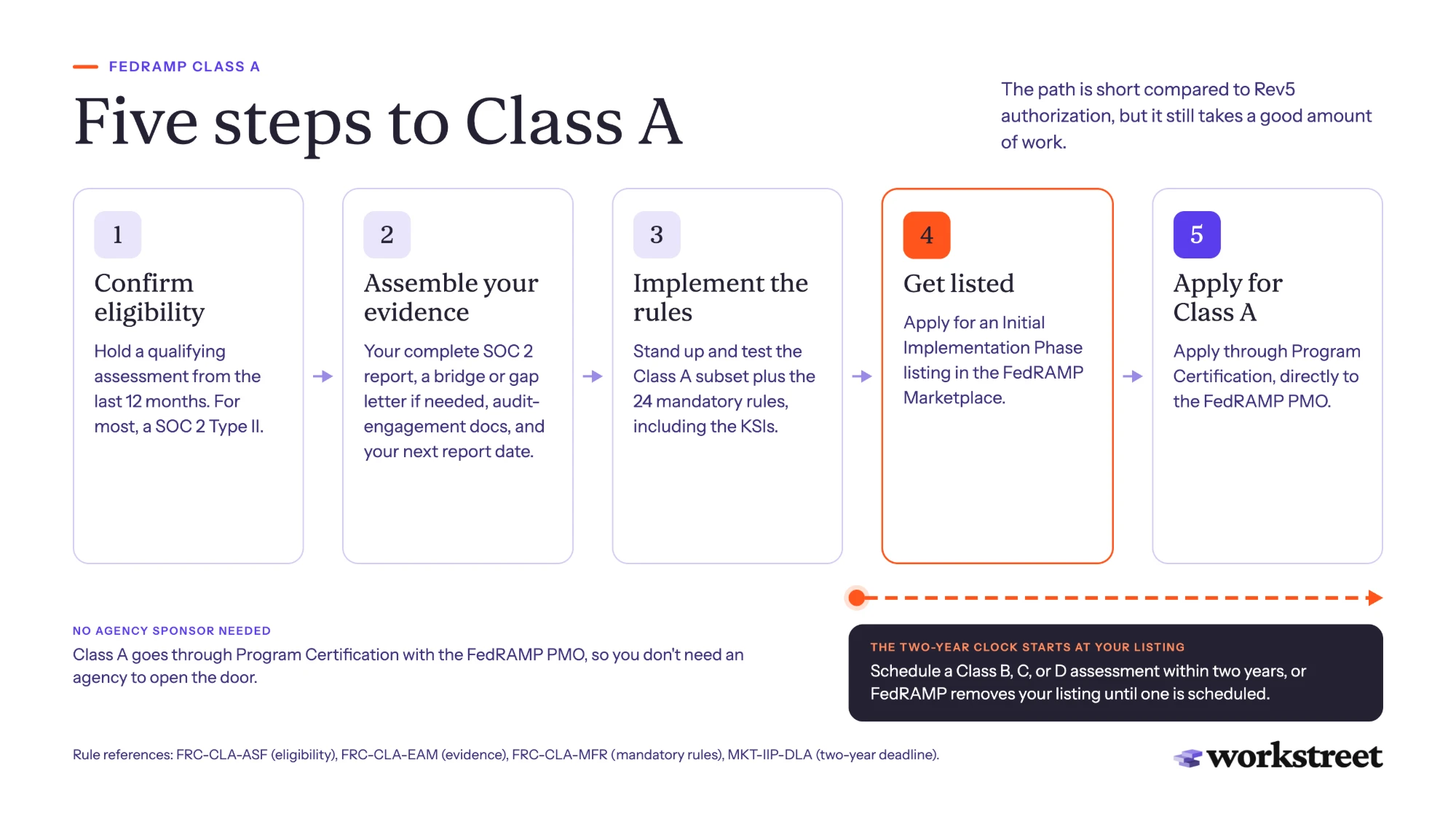
- Confirm your eligibility: Verify you hold a qualifying AASF assessment. This will be SOC 2 Type II for most organizations.
- Assemble your evidence package: Rule FRC-CLA-EAM requires your complete SOC 2 report, a bridge or gap letter if applicable, verified audit-engagement documentation, and the estimated schedule for your upcoming report. Our free Class A evidence checklist tracks every item.
- Implement the mandatory FedRAMP rules: Stand up and test the Class A subset rules plus the 24 listed mandatory rules under FRC-CLA-MFR, which include the relevant FedRAMP 20x KSIs.
- Get listed and start the clock: Apply for an Initial Implementation Phase listing in the FedRAMP Marketplace. FedRAMP requires this listing before you can apply for any certification, and your two-year window to schedule a Class B, C, or D assessment starts when you are listed.
- Submit through Program Certification: Apply for Class A directly to the FedRAMP PMO. The Certification Package goes in as JSON per FedRAMP's schemas; our free Certification Package JSON guide walks through the format.
When Class A Makes Sense (and When It Doesn't)
Class A gets you in the door. From there, you must schedule a Class B, C, or D assessment within two years of your initial Marketplace listing (MKT-IIP-DLA). You don't have to complete it within those two years, but if no assessment is scheduled, FedRAMP removes your listing until one is. So Class A buys you access to the FedRAMP Marketplace. But it doesn't let you skip any of the work required to achieve Class B, C, or D certification.
Your Initial Implementation Phase listing, followed by a Class A certification, places your business in the FedRAMP Marketplace alongside organizations that already hold Class B, C, and D certifications. At the very least, that's good for branding and for getting your name in front of decision-makers at federal agencies. However, each agency will have its own acceptance process. Some will be happy to run low-risk pilots with Class A providers, while others will prefer fully certified (Class B, C, or D) partners for any contracts.
Class A makes sense if you hold a current SOC 2 Type II and you're planning to expand into the federal market through FedRAMP 20x. Class A is a good way to start building your name and getting in front of federal buyers while you progress toward Class B or C certification.
Go straight for a full certification if you are already chasing large contracts that demand Class B or C certification.
Ready to Discuss Class A?
The federal market is opening up to more startups and CSPs. Class A offers an entry point for any business with a valid SOC 2 Type II report or another qualifying assessment, but it's only the first step in the journey to winning government contracts.
If you're weighing this path, the best next step is to map your current security posture so you know where you stand and how much work may be involved in achieving Class A certification. Our step-by-step guide and its free templates are a good place to start.
At Workstreet, we work directly with organizations looking to move from commercial into government and federal work. Our team manages 20+ frameworks for clients, including SOC 2, ISO 27001, FedRAMP, GovRAMP, and CMMC. If you'd like to see where you stand and how much work would be involved in meeting the Class A standards and implementing the required KSIs, connect with our team here — we'd be happy to assist you.